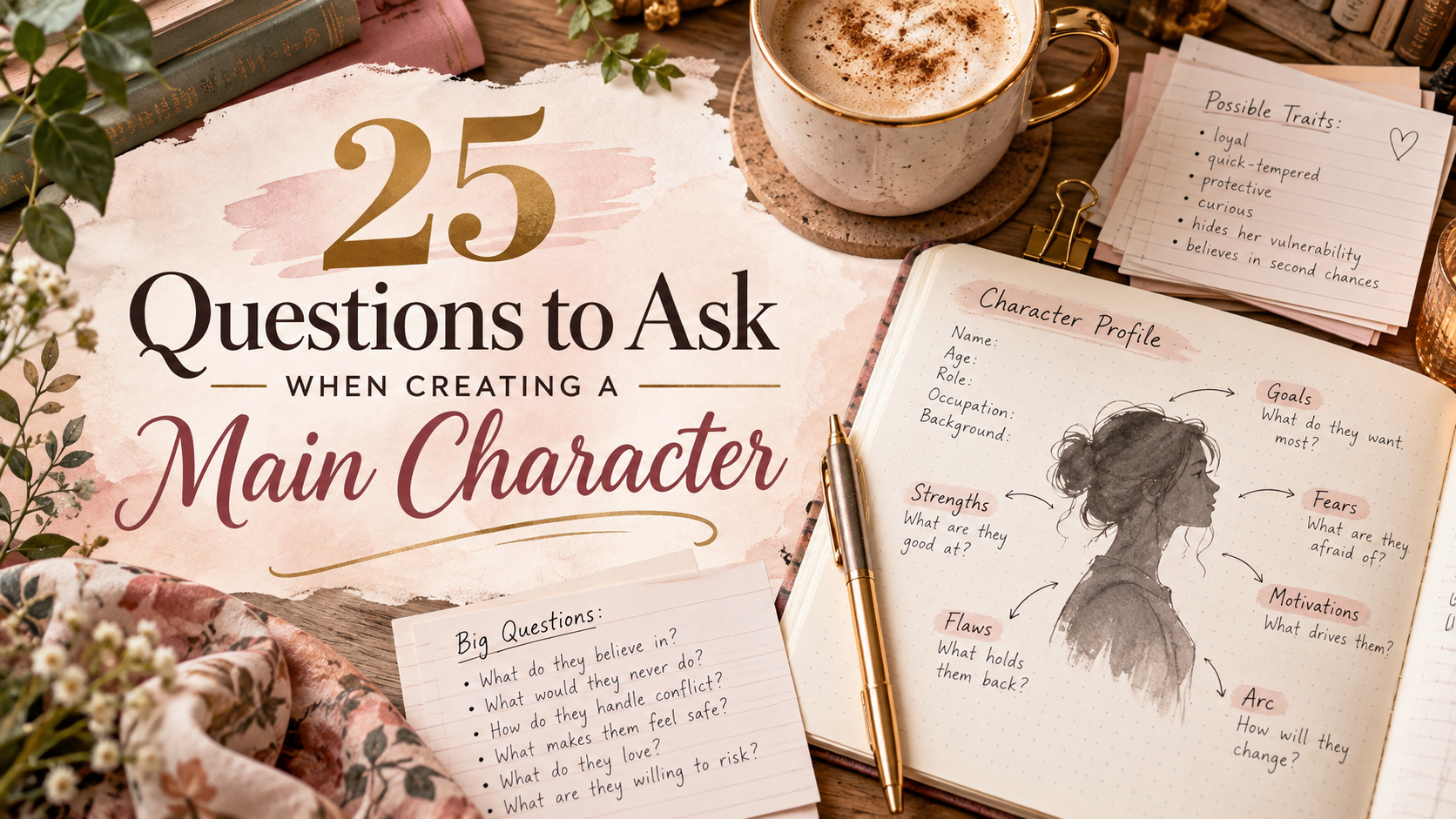
A strong story needs more than an interesting plot. It needs a main character readers can understand, care about, root for, worry about, or sometimes even love to hate.
Your protagonist does not have to be perfect. In fact, they probably shouldn’t be. The most memorable characters usually have fears, flaws, contradictions, secrets, regrets, and desires that influence every decision they make.
But when you first start planning a novel, it can be difficult to know exactly who your main character is.
You might know what they look like. You might know their job or what happens to them in the opening chapter. But those details alone will not necessarily help you create a character who can carry an entire novel.
The questions below can help you move beyond basic character descriptions and discover what truly makes your protagonist tick.
1. What does my character want more than anything?
Every main character should want something.
It might be something concrete, such as winning a competition, finding a missing person, getting a promotion, solving a murder, or escaping a dangerous situation.
It can also be emotional.
Maybe your character wants:
- To feel loved
- To prove themselves
- To belong somewhere
- To earn someone’s forgiveness
- To feel safe
- To start over
Knowing what your character wants gives your story direction.
2. What does my character actually need?
What a character wants and what they need are often two different things.
A woman might want to prove she does not need anyone, while what she actually needs is to learn how to trust.
A man might want revenge, but what he really needs is to let go of the past.
That difference can become the foundation of your character arc.
3. What is my character afraid of?
Fear often influences behavior more strongly than desire.
Consider what frightens your character emotionally as well as physically.
Are they afraid of failure? Abandonment? Losing control? Being vulnerable? Being exposed as a fraud?
A believable fear gives you plenty of opportunities to challenge your protagonist throughout the story.
4. What happened in my character’s past that shaped them?
Characters do not begin existing on page one.
Something happened before your story started that helped create the person they are today.
It does not necessarily need to be a dramatic tragedy.
A childhood friendship, a difficult parent, a failed relationship, an embarrassing mistake, or an important mentor can all shape how someone sees the world.
5. What false belief does my character hold?
Many compelling characters begin a story believing something that is not entirely true.
For example:
- Love always ends in heartbreak.
- Asking for help is a sign of weakness.
- Money determines someone’s worth.
- People cannot change.
- I am not good enough.
- Everyone eventually leaves.
Your story can gradually challenge that belief.
6. What is my character’s greatest strength?
Give your protagonist qualities that help them survive the story.
Maybe they are loyal, determined, funny, intelligent, compassionate, resourceful, or brave.
Their strengths should affect how they approach problems.
They can also become weaknesses when taken too far.
Determination can become stubbornness. Loyalty can make someone overlook bad behavior. Confidence can become arrogance.
7. What is my character’s biggest flaw?
Perfect characters are rarely interesting.
Your protagonist might be:
- Impulsive
- Judgmental
- Stubborn
- Jealous
- Controlling
- Defensive
- Too trusting
- Too independent
A useful flaw should affect the story rather than simply appearing on a character worksheet.
If your character is stubborn, for example, that stubbornness should create problems.
8. What does my character regret?
Regret reveals a great deal about a person.
What does your protagonist wish they could change?
Maybe they never apologized to someone. Maybe they walked away from a relationship. Maybe they chose their career over their family.
That regret might become especially powerful if the events of your novel force them to confront it.
9. What secret is my character keeping?
Secrets instantly create tension.
Your protagonist might be hiding something from another character—or even from themselves.
The secret does not always have to be shocking. Sometimes an emotional secret is just as powerful.
Maybe they secretly want to leave their hometown.
Maybe they are still in love with someone.
Maybe they pretend not to care about something that matters deeply to them.
10. What would embarrass my character?
Small questions can reveal big personality traits.
Would your character hate being caught crying?
Would they be mortified if someone discovered their favorite cheesy television show?
Would public failure destroy them?
Understanding embarrassment helps you understand what your character values and how they want others to see them.
11. How does my character see themselves?
Your character’s opinion of themselves may be very different from reality.
Maybe everyone else sees them as confident while they constantly doubt themselves.
Maybe they believe they are difficult to love even though the people around them clearly care deeply about them.
That difference creates emotional depth.
12. How do other people see my character?
Now consider the opposite perspective.
How would your character’s best friend describe them?
Their enemy?
Their parent?
Their romantic partner?
Different characters should see your protagonist differently.
13. What makes my character angry?
Anger often reveals someone’s values.
A character who becomes furious when someone is bullied probably values fairness.
A character who becomes angry when plans change might value control.
Figure out what pushes your protagonist’s buttons.
Then consider putting those buttons directly in the antagonist’s reach.
14. What makes my character feel safe?
Where does your protagonist go when life becomes overwhelming?
Maybe they call their sister.
Maybe they bake.
Maybe they run.
Maybe they sit on the porch at their childhood home.
These details make characters feel human and can create quieter emotional moments between larger plot events.
15. Who does my character trust the most?
Relationships reveal character.
Who knows the real version of your protagonist?
Is it a sibling? Best friend? Parent? Coworker? No one?
If your character trusts no one, ask yourself why.
And if they trust someone completely, consider what would happen if that trust were tested.
16. Who does my character have the most complicated relationship with?
Complicated relationships create natural conflict.
Your protagonist may love someone they also resent.
They might admire someone they are jealous of.
They might desperately want approval from someone who constantly disappoints them.
These emotional contradictions often produce some of the strongest scenes in a novel.
17. How does my character behave when they are under pressure?
Stress strips away our ability to carefully manage our reactions.
Does your character become:
- Quiet?
- Angry?
- Sarcastic?
- Reckless?
- Controlling?
- Emotional?
- Hyper-focused?
Knowing this will help you keep your protagonist’s reactions consistent during high-stakes scenes.
18. What line would my character never cross?
Everyone has limits.
Your character might lie but refuse to steal.
They might fight but refuse to kill.
They might break rules but never betray a friend.
Once you determine that line, you have an interesting storytelling opportunity:
What could happen that might force them to consider crossing it?
19. What would make my character give up everything?
What matters enough that your character would sacrifice their career, reputation, money, safety, or future?
The answer tells you what they truly value.
It can also help you create the climax of your story.
20. What does my character do when no one is watching?
Characters should have lives beyond what the plot requires.
Maybe your tough detective sings along to old love songs while cooking dinner.
Maybe your elegant businesswoman eats cereal straight from the box at midnight.
Maybe your intimidating warrior secretly sketches flowers.
Private habits can make a character feel surprisingly real.
21. What contradiction exists in my character’s personality?
Real people are full of contradictions.
Your character might be:
- Brave in dangerous situations but terrified of emotional vulnerability.
- Excellent at giving advice but terrible at following it.
- Extremely organized at work but chaotic at home.
- Confident around strangers but insecure around family.
- Cynical about romance while secretly longing to fall in love.
Contradictions keep characters from feeling one-dimensional.
22. What does my character believe about love?
This question is especially useful when writing romance, but it can deepen almost any story.
Does your character believe in soulmates?
Do they think love always fades?
Have they decided relationships are more trouble than they are worth?
Do they desperately want love but pretend they don’t?
Their belief about love will influence how they respond when someone gets close.
23. What would completely change my character’s life?
Think about the event your protagonist would least expect.
A death.
A betrayal.
An unexpected inheritance.
A diagnosis.
A stranger arriving.
An old love returning.
A secret being exposed.
Sometimes the answer becomes your inciting incident.
Other times it becomes the major midpoint or climax of the novel.
24. How will my character be different at the end of the story?
Before writing your protagonist’s journey, think about where they will end up emotionally.
Will they become more trusting?
More independent?
More courageous?
More compassionate?
Will they finally forgive themselves?
Your character does not need to become an entirely different person. Usually, the strongest arcs involve a believable shift in how they see themselves or the world.
25. What happens if my character fails?
This may be the most important question of all.
Why can’t your protagonist simply walk away?
What will they lose?
The consequences might be external:
- Someone dies.
- A relationship ends.
- The villain wins.
- The business closes.
- The family loses their home.
They can also be internal.
Maybe failing would prove everything your character secretly fears about themselves.
The clearer the consequences are, the more invested readers will become.
You Don’t Need to Know Everything Before You Start Writing
Character questionnaires can be incredibly useful, but you do not need to know every detail of your protagonist’s life before you write Chapter One.
You probably don’t need to know their favorite ice cream flavor unless ice cream becomes important to the story.
Focus instead on the questions that influence motivation, conflict, relationships, choices, and change.
Those are the details that help turn a fictional character into someone readers believe exists beyond the page.
And don’t be surprised if your character changes as you write.
Sometimes the person you thought you created reveals something completely unexpected halfway through the manuscript.
That’s part of the fun.
Final Thoughts
Creating a memorable main character is less about building the perfect character profile and more about understanding why your protagonist does what they do.
Know what they want.
Know what they fear.
Know what they’re hiding.
Know what they believe.
Then create a story that challenges every one of those things.
When your character is forced to make difficult choices, confront uncomfortable truths, and risk something that matters deeply to them, you have the foundation for a character readers will want to follow all the way to the final page.
Subscribe to our newsletter to get the latest blog articles and book news.
